
On this page 11 sections
Clock skew is usually treated as a problem to minimize. In physical design and STA it is also a tool. Shifting when the launch or capture clock edge arrives changes that path’s setup and hold budgets by the same amount. Applied on purpose—useful skew—it can close a path a balanced tree cannot, without editing the data path. Used carelessly, it creates hold failures and OCV surprises.
This guide covers what useful skew is, the setup/hold equations, how CTS schedules it at a high level, trade-offs, and ECO/MBFF interactions. Worked-example numbers are illustrative. Related reading: Clock Tree Synthesis (CTS), Setup and Hold Violations, Static Timing Analysis (STA) in VLSI, ECO in VLSI Physical Design, Multicycle Path and False Path in STA, Clock Gating and ICG, Multi-Bit Flip-Flop Banking, Time Borrowing (Cycle Stealing), Latch vs Flip-Flop and Temperature Inversion.
What clock skew is#
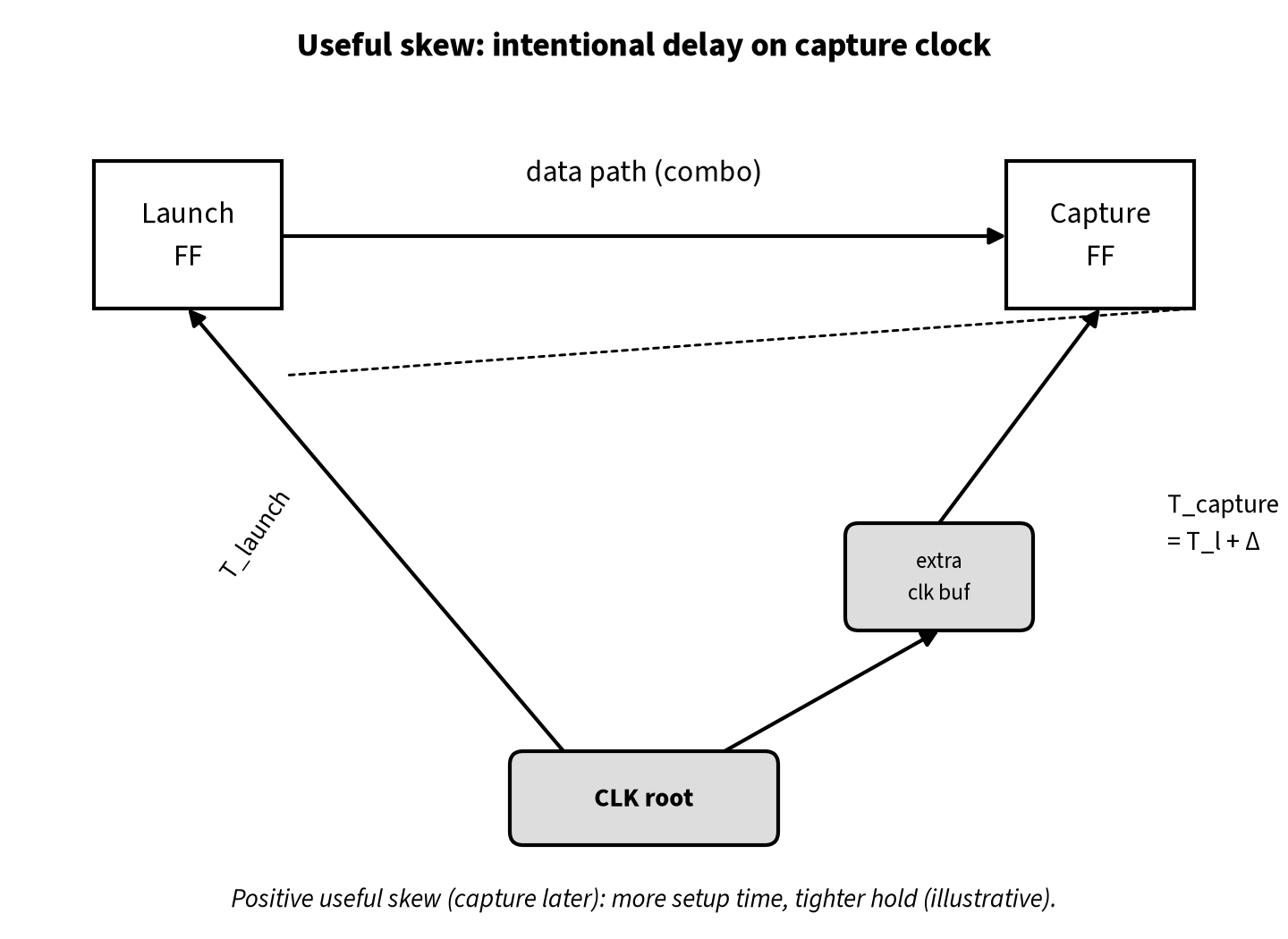
For a timing path from a launch flip-flop to a capture flip-flop, clock skew is the difference in arrival time of the active clock edge at the two clock pins:
\[ \text{skew} = T_{\text{capture}} - T_{\text{launch}} \]
With this sign convention (common in many STA reports and textbooks):
- Positive skew means the capture clock arrives later than the launch clock.
- Negative skew means the capture clock arrives earlier than the launch clock.
Two related terms appear in interviews and CTS reports:
| Term | Meaning |
|---|---|
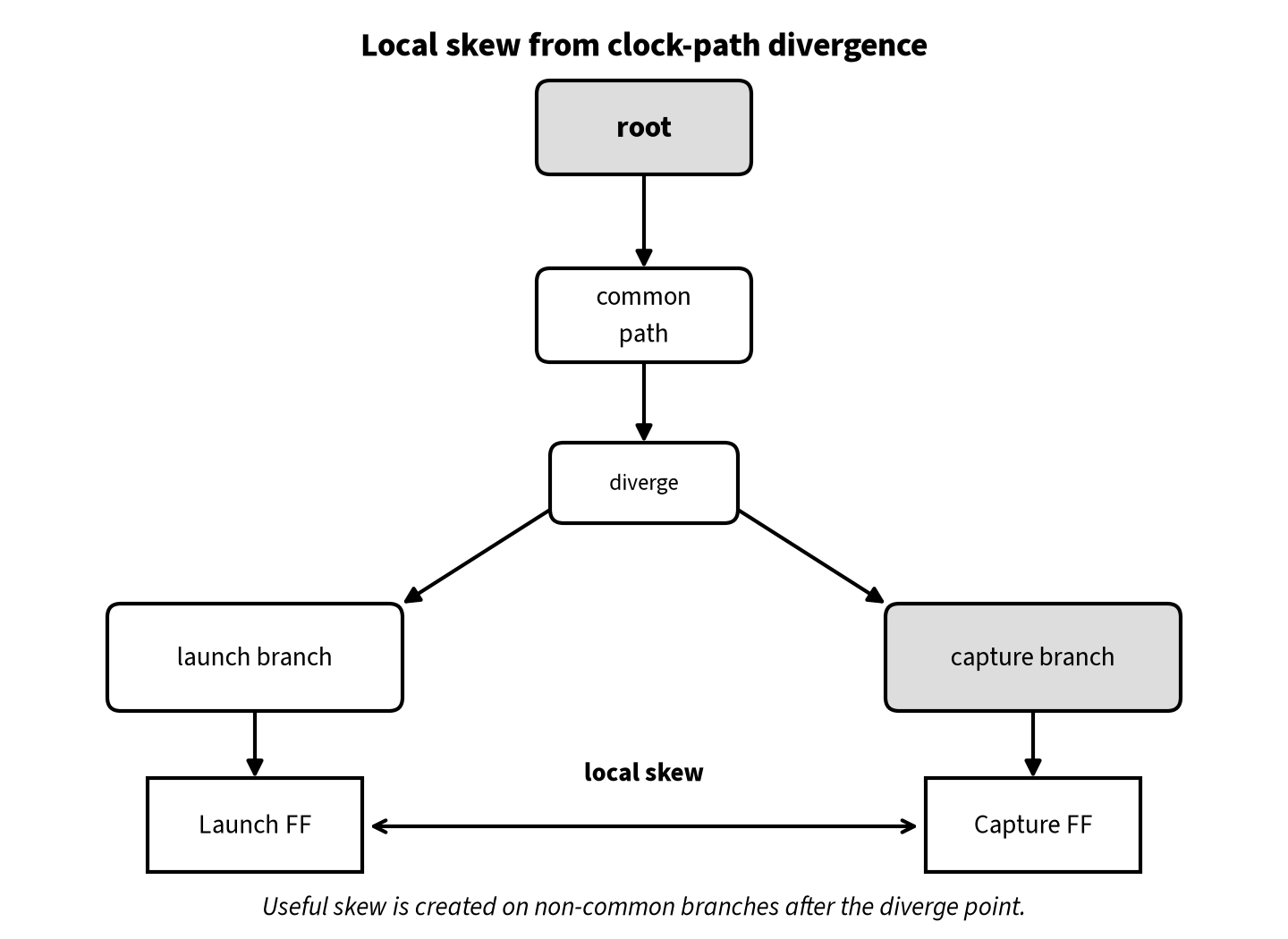
| Local skew | Skew between a specific launch–capture pair (or a small group of related flops). This is what setup and hold equations use for that path. |
| Global skew | Spread of clock arrival times across a larger set of sinks—often the whole domain—relative to a reference. Useful for CTS quality metrics; not the same as any one path’s local skew. |
Local skew is what timing cares about on a path. Global skew being small does not guarantee every local pair is balanced, and a large global skew does not mean every path fails. For background on how CTS builds the tree that creates these arrivals, see Clock Tree Synthesis.
Unintentional skew versus useful skew#
Unintentional skew is whatever residual difference remains after CTS tries to balance arrivals: uneven buffer trees, unequal wire lengths, load mismatch, on-chip variation, and placement that forces long clock routes. You manage it with better balancing, more carefully chosen sinks, and margins (OCV/AOCV/POCV derates). You do not plan to rely on it for closure.
Useful skew (also called intentional skew or scheduled skew) is a deliberate offset of clock arrival at selected sinks so that critical setup paths get more time and non-critical paths give that time up. The data-path netlist may stay the same; only clock arrivals change. In practice the CTS or clock-scheduling step inserts or sizes clock buffers, or chooses unequal branch delays, so that launch edges for hard paths arrive earlier and/or capture edges arrive later—within hold and pulse-width limits.
Useful skew is not the same as time borrowing with latches. Latch time borrowing uses the transparency window of a level-sensitive latch. Useful skew moves edge-triggered flop clock arrivals. Both redistribute cycle time across stages; the mechanisms and STA checks differ.
Setup and hold equations with skew#
For a single-cycle path between edge-triggered flops clocked by the same edge of the same domain, a common form of the checks (library setup/hold times \(T_{\text{su}}\) and \(T_{\text{h}}\), clock period \(T_{\text{clk}}\), data path delay \(T_{\text{dp}}\), clock network delays as above) is:
Setup (slow corner / late data, early clock):
\[ T_{\text{launch(late)}} + T_{\text{dp(max)}} + T_{\text{su}} \le T_{\text{clk}} + T_{\text{capture(early)}} \]
Rearranged with \(\text{skew} = T_{\text{capture}} - T_{\text{launch}}\) (using the appropriate early/late values in real STA):
\[ T_{\text{dp(max)}} \le T_{\text{clk}} - T_{\text{su}} + \text{skew}_{\text{setup}} \]
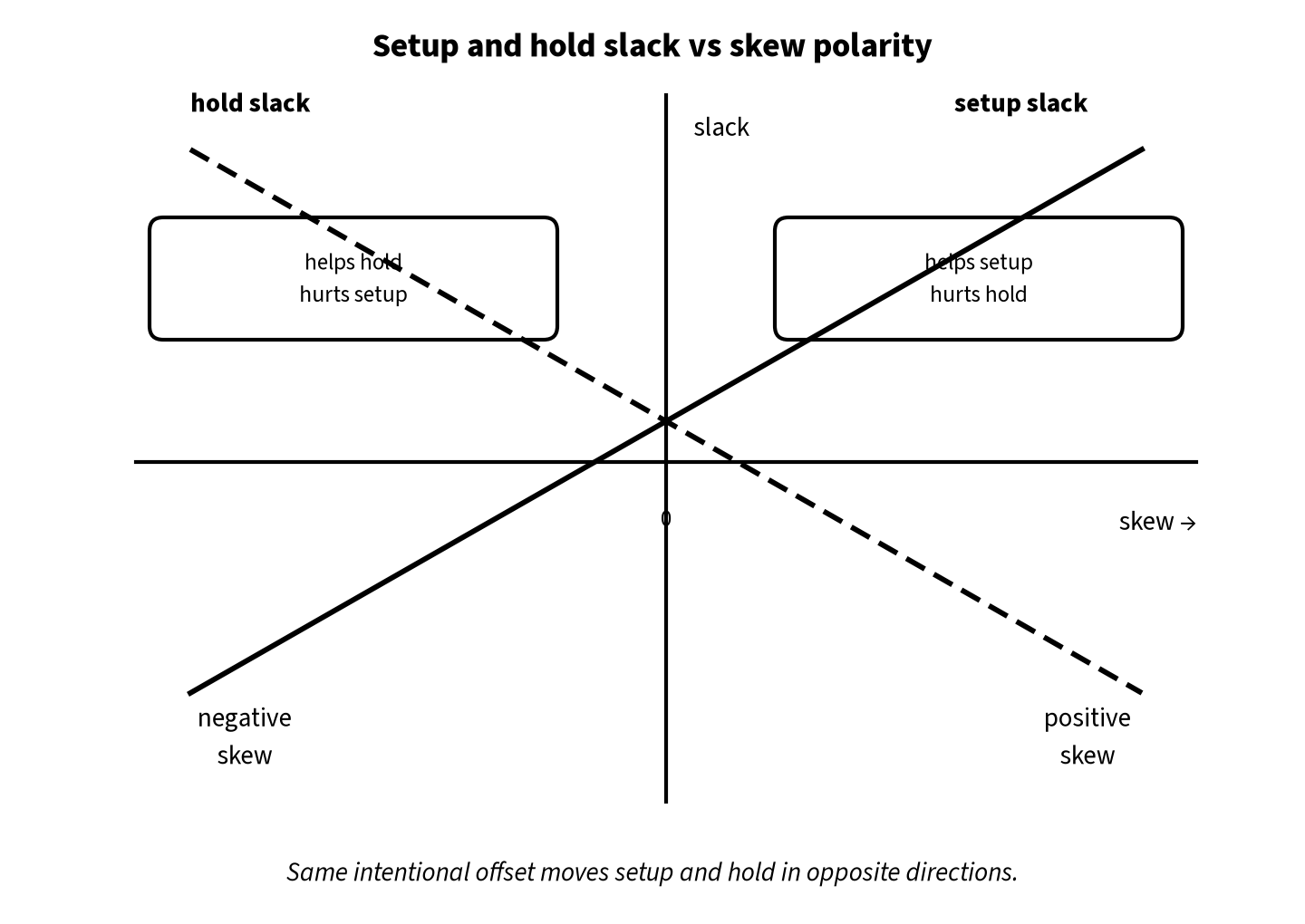
Positive useful skew (capture later / launch earlier in the sense that helps setup) increases setup slack. Negative skew decreases it.
Hold (fast corner / early data, late clock):
\[ T_{\text{launch(early)}} + T_{\text{dp(min)}} \ge T_{\text{capture(late)}} + T_{\text{h}} \]
or, roughly,
\[ T_{\text{dp(min)}} \ge T_{\text{h}} + \text{skew}_{\text{hold}} \]
The same positive skew that helped setup hurts hold. Hold does not get a full period of margin; it is a same-edge race. That is the central trade-off of useful skew. Details of how STA reports these paths are covered in Setup and Hold Violations and STA in VLSI.
Worked example 1: positive useful skew closes setup (illustrative)#
All numbers below are made up for teaching; they are not silicon measurements.
- \(T_{\text{clk}} = 1.0\,\text{ns}\)
- \(T_{\text{su}} = 40\,\text{ps}\), \(T_{\text{h}} = 20\,\text{ps}\)
- Data path max delay \(T_{\text{dp(max)}} = 980\,\text{ps}\), min delay \(T_{\text{dp(min)}} = 120\,\text{ps}\)
- Balanced tree: local skew ≈ 0
Setup requirement without skew: \(T_{\text{dp(max)}} \le 1000 - 40 = 960\,\text{ps}\). Actual 980 ps → −20 ps setup slack.
Apply +40 ps useful skew (capture arrival later by 40 ps relative to launch, in the setup sense):
- New setup limit ≈ \(960 + 40 = 1000\,\text{ps}\) → slack ≈ +20 ps.
- Hold: the extra 40 ps of positive skew tightens hold. Rough check: need \(T_{\text{dp(min)}} \ge T_{\text{h}} + \text{skew}\) → \(120 \ge 20 + 40 = 60\) → still +60 ps hold slack.
Useful skew fixed setup without touching the data path, and hold remained comfortable.
Worked example 2: the same skew creates a hold fail (illustrative)#
Keep the same clocks and setup times, but shorten the data path min delay to \(T_{\text{dp(min)}} = 45\,\text{ps}\) (a short path through a few cells next to each other). With +40 ps useful skew:
- Setup still gains ~40 ps (good if that path was critical).
- Hold: \(45 \ge 20 + 40 = 60\)? No → about −15 ps hold slack.
You must either reduce the intentional skew, add hold buffers / delay cells on the short path, or choose a different scheduling that does not push this pair. Useful skew is never “free”; hold and pulse-width limits are the bill.
Worked example 3: negative skew to protect hold (illustrative)#
A short path has hold slack −25 ps at the fast corner with near-zero skew, and the launch–capture pair has +150 ps setup slack at the slow corner. Applying −30 ps skew (capture earlier relative to launch, in the hold-friendly sense) can recover hold by ~30 ps while spending ~30 ps of setup margin—still leaving ~+120 ps setup if the estimate holds after re-extraction. That is useful skew applied for hold recovery rather than setup closure. In ECO practice, hold buffers are often preferred when they are local and cheap; skew scheduling is more attractive when many paths share the same clock sinks.
How CTS and clock scheduling apply useful skew#
At a high level (tool flows differ; this is conceptual, not a vendor recipe):
- Build a balanced tree so that most sinks see similar arrival and transition. Global skew and local skew targets are set in the CTS specification.
- Identify critical setup endpoints from STA (or from a timing-driven CTS engine that already sees path slack).
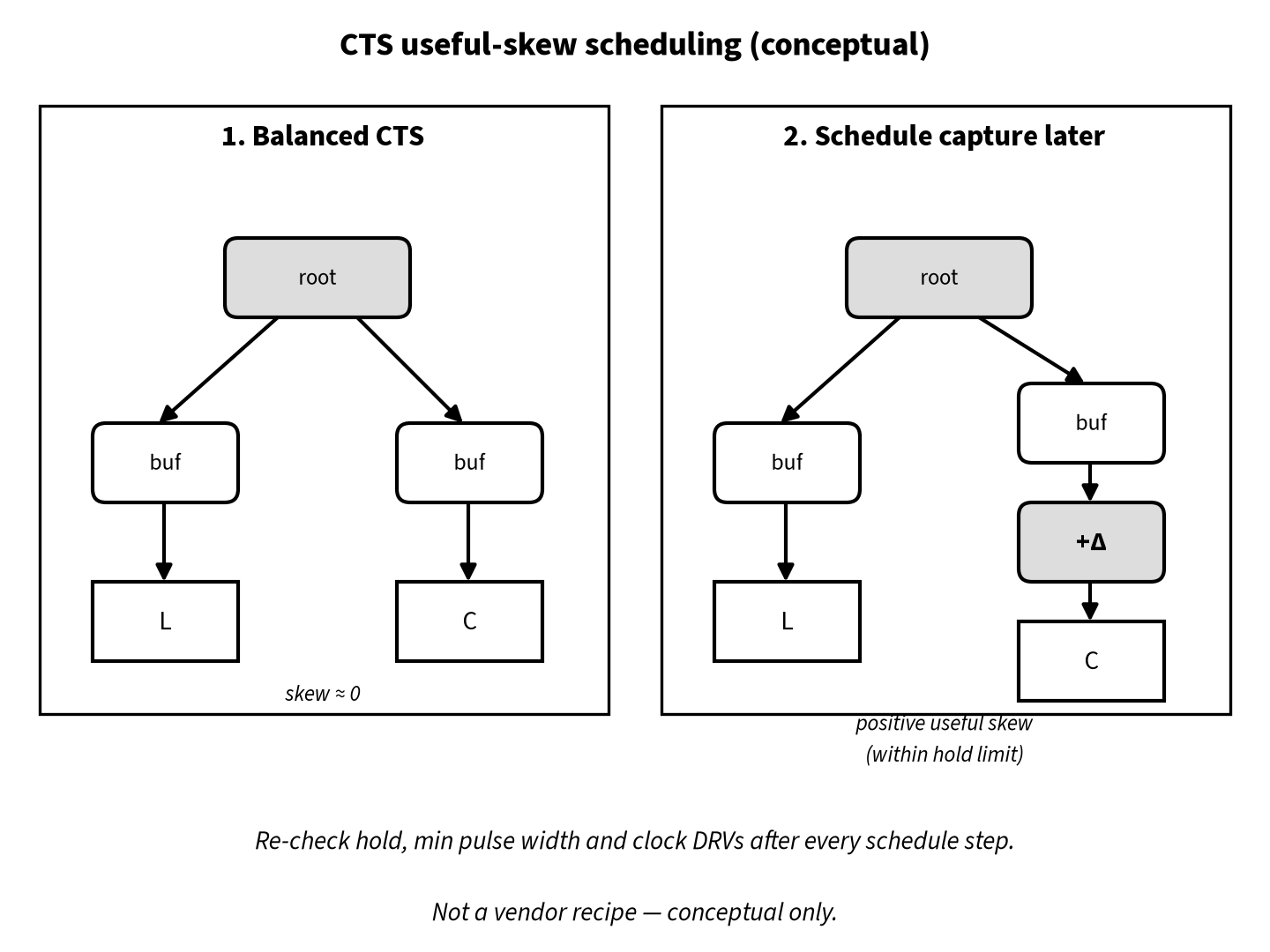
- Schedule arrivals: move selected sink arrivals earlier (launch of critical paths) or later (capture of critical paths) by inserting or upsizing clock buffers on specific branches, or by allowing intentional imbalance within a skew bound.
- Re-check hold, min pulse width, and clock DRVs after every scheduling step. Clock cells themselves must meet max transition and pulse-width rules.
- Iterate with updated parasitics and multi-corner STA. On-chip variation and CRPR change how much of the scheduled skew “counts” in setup versus hold.
Useful-skew CTS is therefore not “unbalance everything.” It is bounded, path-aware redistribution of arrival times under hold and clock-integrity constraints. Clock gating and ICG cells sit on some of those branches; see Clock Gating and ICG for how gated clocks complicate common-path structure.
Trade-offs, limits, and OCV / CRPR caveats#
What useful skew buys
- Extra setup margin without upsizing every data-path cell.
- Closure when sizing/Vt swaps are exhausted or power-limited.
- Sometimes lower power than blanket LVT/upsizing on long cones.
What it costs
- Hold margin on the same pairs and on other paths that share those sinks.
- Clock power/area from extra or larger clock buffers.
- Harder debug and less margin left for late ECOs on the same sinks.
OCV / AOCV / POCV (conceptual). Derates make launch and capture clock paths look more pessimistic for setup and hold. Part of a scheduled offset can be eaten by variation margins, so the “+40 ps” you inserted may not appear as +40 ps of setup slack in sign-off STA. Advanced OCV models and path-based analysis change the numbers; the qualitative message stays: do not assume ideal-clock arithmetic equals sign-off slack.
CRPR (clock reconvergence pessimism removal). When launch and capture clocks share a common path from the root to a divergence point, STA should not apply full independent pessimism on that shared segment. Useful skew is created on the non-common branches after divergence. If you think you scheduled 50 ps but most of the tree is common, the effective local skew at the sinks is what matters—and CRPR affects how much pessimism remains on the divergent parts. See the OCV/CRPR discussion in STA in VLSI.
Other limits. Min pulse width and duty-cycle distortion can forbid aggressive branch delays. Keep multicycle/false paths correctly constrained so the scheduler does not “fix” unreal paths; see Multicycle Path and False Path. Useful skew inside one domain does not redefine CDC interfaces.
Physical design, ECO, and MBFF notes#
Placement and CTS interaction. Useful skew works best when launch and capture flops of critical paths can share a deep common clock path and then diverge with controlled branch delay. Scattering related flops across the floorplan forces early divergence, large unintentional local skew, and less clean scheduling. Floorplan and placement that keep timing-related registers together help both balancing and intentional skew.
ECO use. After route, a timing ECO can still tweak useful skew by resizing or inserting clock buffers on selected branches. A data-path size/buffer change is often cleaner; skew ECO helps when many paths share one sink and one branch tweak helps the group. Re-check hold, pulse width and SI on clock nets. See ECO in VLSI Physical Design.
Multi-bit flip-flops (MBFF). Banking merges bits into one cell with a shared clock pin, so those bits cannot be scheduled independently. Banking saves clock power and sink count but reduces per-bit skew freedom; debank when one bit needs a different schedule. Details: Multi-Bit Flip-Flop Banking.
Debugging flowchart#
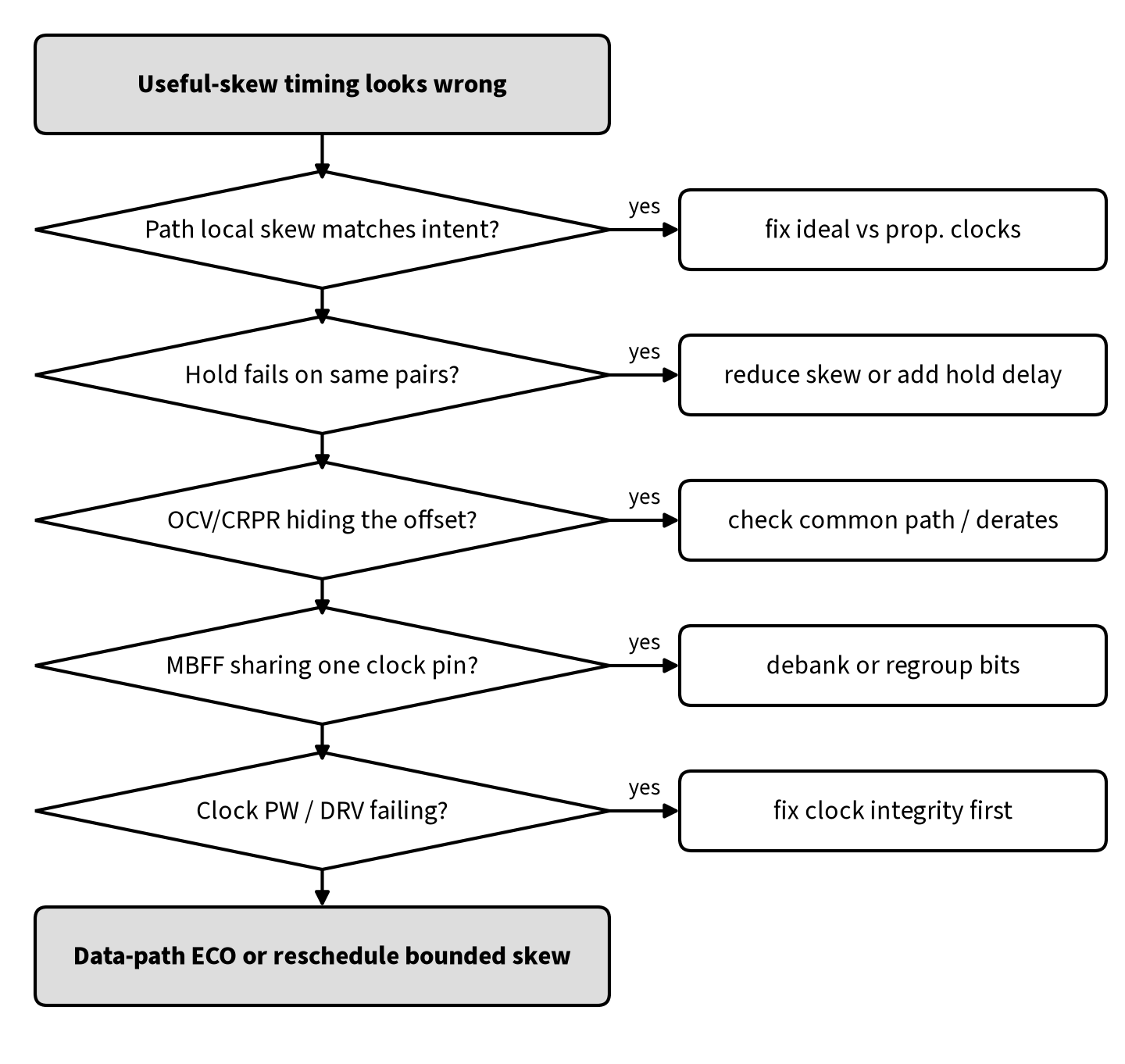
When setup looks fixed by skew but hold or other paths explode—or when scheduled skew does not show up in slack—the order below is a practical debug sequence.
Common findings:
- Report skew ≠ intended schedule — wrong corners, ideal vs propagated clocks, or looking at global skew instead of the path’s local skew.
- Setup improved, many new hold fails — scheduled positive skew too large for min-delay paths; add hold fixes or reduce skew.
- Little setup gain after large schedule — OCV/CRPR ate the offset, or the divergence point is too close to the sinks so little non-common delay was added.
- One bit fails after banking — MBFF shared clock; consider debank or a different bank grouping.
- Pulse-width or duty fails — clock branch too heavy or poorly tapered; fix clock integrity before chasing data slack.
Interview questions and answers#
1. What is useful skew in VLSI?
Useful skew is intentional difference in clock arrival time between launch and capture flops, applied so that critical setup (or hold) paths get more margin. It is planned during CTS or clock scheduling, not accidental residual imbalance.
2. How does positive skew affect setup and hold?
With the usual \(T_{\text{capture}} - T_{\text{launch}}\) sign, positive skew helps setup (more time for data) and hurts hold (tighter same-edge race). Negative skew does the opposite.
3. Local skew vs global skew?
Local skew is the arrival difference for a specific launch–capture pair (what the path equations use). Global skew describes spread across many sinks and is a CTS quality metric, not a substitute for path timing.
4. Is useful skew the same as latch time borrowing?
No. Time borrowing uses latch transparency; useful skew shifts edge-triggered clock arrivals. Both redistribute time across stages; STA checks differ.
5. Why can useful skew fail to show full benefit under OCV?
Derates add pessimism on clock paths. Part of an intentional offset can be absorbed by variation margins, and CRPR changes how shared versus divergent clock segments are treated. Sign-off slack is not ideal-clock arithmetic.
6. When would you prefer a data-path ECO over a skew ECO?
When the failure is local to one path, when hold margin is already thin, when clock DRVs or pulse width are tight, or when shared sinks would drag many unrelated paths. Skew ECO fits better when many paths share a sink and one branch tweak helps the group.
7. How do MBFFs interact with useful skew?
Bits in one MBFF share a clock pin, so they share one arrival and cannot be scheduled independently. That can force debanking when skew needs differ per bit.
8. Can useful skew fix a multi-period violation?
No. It only redistributes time within roughly one period and hold limits. Large fails need logic change, a valid multicycle exception, architecture change, or a lower frequency.
9. What must you re-check after applying useful skew?
Setup and hold in all relevant corners/modes, local skew on affected pairs, clock max transition/capacitance, min pulse width/duty cycle, and SI on changed clock nets.
10. Unintentional vs useful skew?
Unintentional skew is residual imbalance after balancing; useful skew is a deliberate, constrained offset used for timing closure.
11. Is zero skew always best?
Not always. Zero skew is a clean start, but path-aware useful skew can close timing at lower data-path power when stage delays are uneven—if hold and clock integrity still pass.
12. Where does useful skew appear in the PD flow?
After placement, during/after CTS and clock optimization, and sometimes in post-route ECO. SDC, ICG structure and MBFF banking shape what scheduling is possible.
FAQ#
Is useful skew only for setup?
No. Negative intentional skew (or reducing prior positive skew) is also used to help hold, though local hold buffers are often the first ECO choice.
Does useful skew change functional behavior?
It should not change logic function. It changes when flops sample relative to each other. Incorrect constraints or broken clock gating can still cause functional issues; LEC still applies to netlist edits, and timing must remain clean.
How much useful skew is typical?
It depends on the design. Teams set bounds from hold slack, pulse-width limits and clock power—not from a universal picosecond number.
Can I apply useful skew across asynchronous clock domains?
Not as a substitute for proper CDC. Useful skew is a same-domain (or carefully defined related-clock) concept. Asynchronous interfaces need synchronizers and CDC methodology, not scheduled skew between unrelated roots.
Why do interviewers ask this topic?
It tests whether you understand setup/hold as a pair, what CTS actually optimizes, and that clock is a first-class timing resource—not only a tree to balance.
Summary#
- Clock skew is the difference in clock arrival between launch and capture; local skew enters setup and hold equations, while global skew is a broader CTS metric.
- Useful skew is intentional, bounded skew used to close timing; unintentional skew is residual imbalance.
- Positive useful skew helps setup and hurts hold; the reverse holds for negative skew. Worked numbers in this post are illustrative.
- CTS / clock scheduling applies useful skew by shaping branch delays after a balanced baseline, then re-checking hold, pulse width and clock DRVs.
- OCV and CRPR mean scheduled offsets do not translate one-for-one into sign-off slack.
- Placement, ECO and MBFF banking all constrain how freely you can schedule per-bit arrivals.
- Debug with path local skew, hold on the same pairs, common-path / CRPR awareness and clock-integrity checks—not with global skew alone.
References#
- J. Bhasker and R. Chadha, Static Timing Analysis for Nanometer Designs: A Practical Approach, Springer, 2009.
- A. B. Kahng, J. Lienig, I. L. Markov and J. Hu, VLSI Physical Design: From Graph Partitioning to Timing Closure, Springer, 2011.
- Clock Tree Synthesis (CTS) in VLSI Physical Design
- Setup and Hold Violations
- Static Timing Analysis (STA) in VLSI
- ECO in VLSI Physical Design
- Multi-Bit Flip-Flop Banking
- Time Borrowing (Cycle Stealing) in VLSI

Written by
Swasti Pujari
Associate Director, Backend Engineering at CoreIC Technologies, with 15+ years in VLSI Physical Design and backend engineering. Previously Practice Head at UST Global, leading Physical Design, STA, EMIR, DFT, and Physical Verification. Delivered 3nm, 6nm and 7nm projects for AMD, Intel, and Microchip, and published IEEE research on hybrid AI-EDA floorplanning.